Every business begins with a way of getting things done.
Orders may be recorded in a spreadsheet. Customer details may be stored in different folders. Approvals may happen over email or messaging apps. Reports may be prepared manually at the end of every week.
For a while, this works.
The team knows where everything is, people remember what needs to happen next, and the number of transactions remains manageable. But as the business grows, the same arrangement can slowly become difficult to maintain.
Files become harder to track. Information gets entered more than once. Teams spend time following up on routine tasks. Small mistakes begin affecting customers, reporting and everyday operations.
This is often the point when a business starts considering custom software.
The Tools You Started With May No Longer Be Enough
Ready-made software is useful because it allows businesses to start quickly. It can handle common requirements without the time or cost involved in building a new system.
However, most standard software is designed for a broad range of users. Your business may have its own approval process, pricing structure, reporting format or customer journey that does not fit neatly into a standard platform.
Teams then begin creating workarounds.
A spreadsheet is maintained beside the main software. Reports are exported and corrected manually. Employees switch between several applications to complete one task. Important information is passed through emails because the system does not support the required workflow.
The software may still be functioning, but it is no longer making the work simpler.
Signs That Custom Software May Be the Right Step
There is no single moment when every business should move to a custom system. The need usually becomes visible through repeated operational problems.
One common sign is excessive manual work.
When employees spend hours copying data, preparing repetitive reports or updating the same information in different places, a customised platform can automate much of that process.
Another sign is disconnected information.
Sales, inventory, customer service and finance teams may each use separate tools. This makes it difficult to get a complete view of the business. A custom system can connect these functions and provide relevant information through one structured platform.
Businesses may also need custom software when their workflow is highly specific.
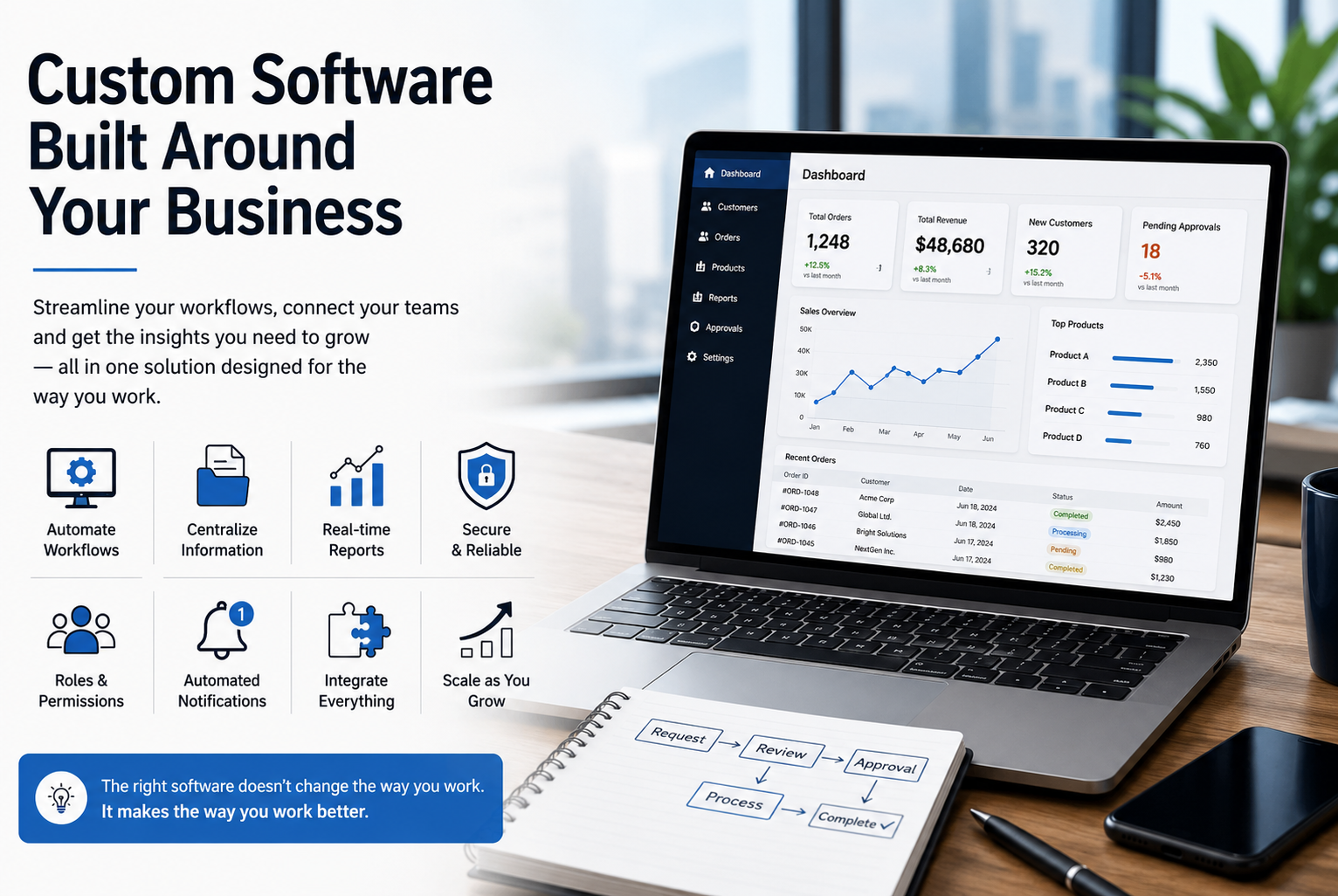
For example, a company may require multiple approval stages, different permissions for different users, automated notifications, document uploads and real-time status tracking. Trying to force this process into standard software can make the workflow more complicated instead of easier.
Custom Software Should Follow the Business
A useful custom platform is not simply a digital version of an existing form.
It should understand how people work, where delays occur and which steps can be simplified.
The development process should begin by studying the business workflow. This includes identifying who creates information, who reviews it, which decisions require approval and what reports are needed.
Once the workflow is clear, the software can be designed around it.
- Routine tasks can be automated.
- Information can move automatically between departments.
- Users can see only the functions relevant to their roles.
- Managers can access dashboards without waiting for manually prepared reports.
The result is a system that supports the business instead of asking the business to adjust itself around the software.
It Can Also Improve the Customer Experience
Operational efficiency is not only an internal benefit.
When systems work smoothly behind the scenes, customers often experience faster responses, clearer communication and fewer errors.
An e-commerce company may provide more accurate order updates. A service business may respond to enquiries more quickly. A distributor may give customers real-time information about availability or delivery.
These improvements may appear small individually, but together they create a more reliable customer experience.
Custom Does Not Have to Mean Complicated
Businesses sometimes avoid custom development because they imagine a large and difficult software project.
But a custom system does not always need to replace everything at once.
It can begin with one important process.
A company might first automate its approval workflow, create a customer portal, build an internal dashboard or connect two existing platforms. Once that part is working well, more functions can be added gradually.
This approach keeps the project focused and allows the software to grow with the business.
Building for What Comes Next
The purpose of custom software is not to add more technology to the workplace.
It is to remove unnecessary effort.
The right system should reduce repeated tasks, organise information and make everyday decisions easier. It should also be flexible enough to support new users, services, locations and operational requirements as the business expands.
At Symmetrix Systems, we build websites, applications, software platforms and automation solutions around practical business needs. The focus is not simply on developing features, but on creating systems that people can use comfortably in their everyday work.
Because when technology fits the way a business actually works, growth becomes easier to manage.