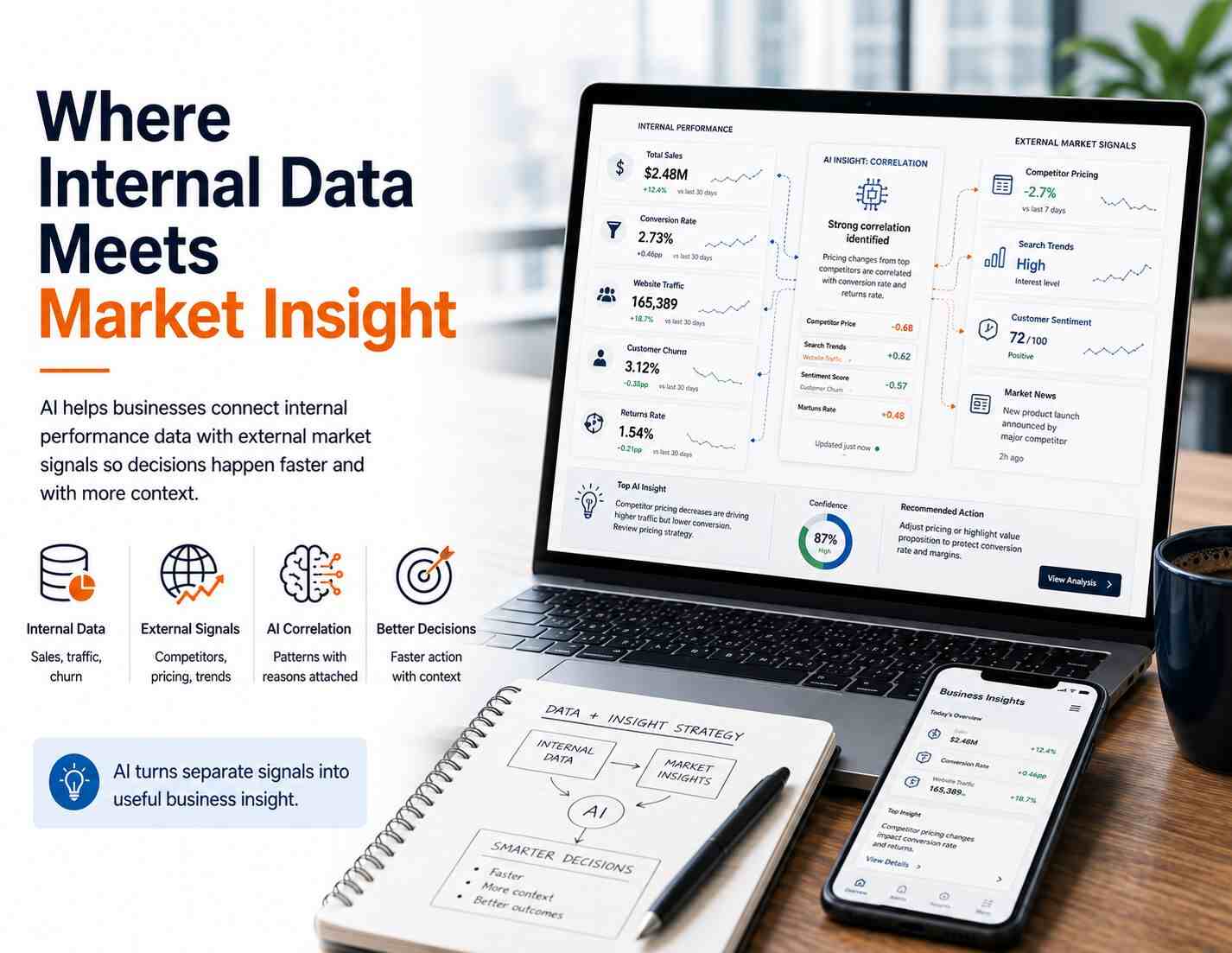
Businesses have always needed two different kinds of insight. One is internal, what is actually happening in the numbers, sales, traffic, churn. The other is external, what is happening in the market around them, what competitors are doing, where prices are moving, what customers are starting to expect. These used to be handled by completely different processes, and neither one moved particularly fast.
Reading your own data used to need a person watching it
Spotting a real pattern in internal data traditionally meant someone on staff, or an agency, going through reports by hand looking for something worth acting on. That works, but it is slow, and it depends entirely on someone remembering to look in the first place. AI tools built into dashboards now do a version of that work automatically, flagging a drop in conversions or an unusual spike in returns before anyone has gone looking for it.
Market insight used to mean waiting for a report
Understanding the market outside the business was even slower. Competitor pricing, industry shifts, changing customer sentiment, all of it usually arrived through quarterly research reports or a lot of manual searching. By the time the insight reached anyone useful, it was often already a few months old. AI-powered tools can now scan public data, news, and pricing pages continuously, surfacing a shift while it is still happening rather than after the fact.
Where the two are starting to overlap
The more useful shift is what happens when internal and external data get read together. A sudden drop in repeat purchases means very little on its own. The same drop, next to a competitor’s new pricing or a shift in search trends for your category, starts to explain itself. That kind of correlation used to require a skilled analyst connecting dots manually. AI systems are increasingly able to do a first pass of that connecting automatically, which is where the real value sits, not in more data, but in data that already comes with a reason attached.
None of this replaces judgment. It just means the judgment gets applied to something closer to the full picture. If your business is still treating internal reporting and market awareness as two separate jobs, that gap is usually where AI can help first.