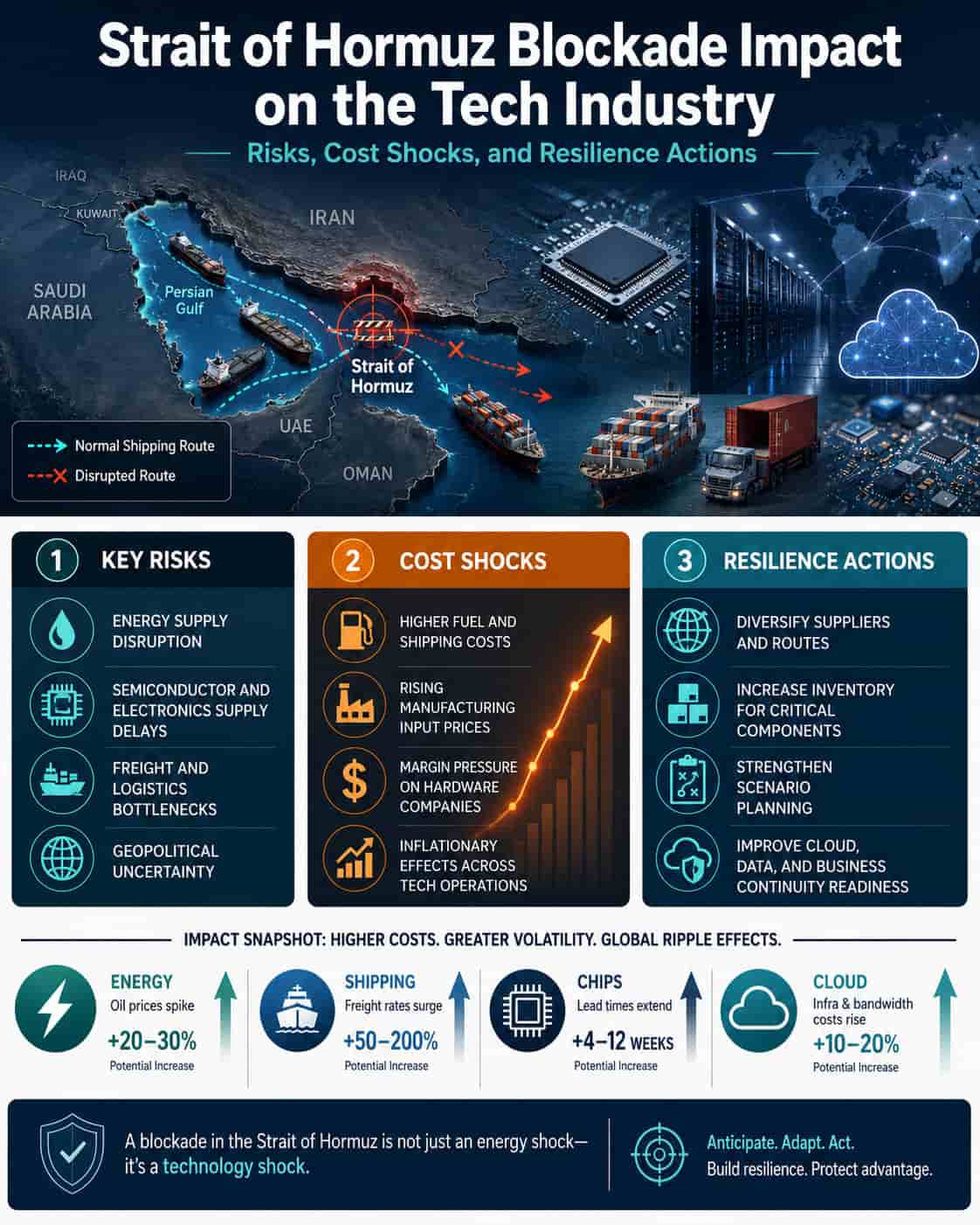
Why the Strait of Hormuz Matters to Technology Operations
The Strait of Hormuz is one of the world’s most critical maritime chokepoints for oil and LNG movement. When passage risk rises, technology leaders can feel operational pressure quickly, even if their infrastructure is geographically far from the Gulf. Energy, transport, and component flow are tightly connected to tech uptime, procurement cycles, and cost control.
Global energy and trade institutions consistently track Hormuz as a high-impact route. For CIO and CTO teams, that means disruption signals should be treated as operational risk inputs, not distant geopolitical noise.
Primary Impact Pathways Into the Tech Sector
Energy Price Shock and Power-Cost Volatility
Blockade risk can increase crude and LNG price volatility. For tech organizations, that can raise electricity costs directly or indirectly through utility pricing and cloud provider structures. Data center-heavy workloads and AI operations are especially sensitive to energy swings.
Freight Disruption and Lead-Time Instability
When maritime routes face uncertainty, insurers reprice risk, carriers reroute capacity, and schedules become less predictable. Even if finished hardware does not transit Hormuz directly, global shipping adjustments can delay servers, networking gear, and replacement parts.
Vendor Concentration and Cascading Dependencies
Tech supply chains often rely on multi-tier vendors with limited sub-supplier visibility. A disruption in one region can cascade into unrelated SKUs through materials, packaging, or transport bottlenecks.
Why Tech Feels These Shocks Fast
Cloud and Data Center Economics
Power is a major operating line item for compute-intensive environments. If energy and logistics costs move together, organizations may face higher operating expenses and slower hardware refresh timelines at the same time.
Hardware Procurement Sensitivity
Enterprise technology procurement depends on forecast accuracy. During disruption periods, lead-time ranges widen, substitutions become harder, and emergency buys become more common.
Semiconductor Flow Exposure
Semiconductor ecosystems are globally distributed and timing-sensitive. Regional transport disruption can affect upstream materials, assembly timing, or downstream delivery consistency, even without a single-point shutdown event.
Scenario Comparison: Short-Term Shock vs Prolonged Blockade
Short-Term Shock (Days to a Few Weeks)
- Fast increase in market volatility and risk premiums.
- Temporary carrier and insurer adjustments that distort delivery commitments.
- Immediate pressure on inventory visibility and executive reporting cadence.
Prolonged Blockade (Multiple Weeks to Months)
- Sustained cost pressure across energy, shipping, and procurement.
- Longer-term allocation behavior from suppliers and tighter contract terms.
- Need for structural response: alternate sourcing, policy updates, and revised continuity thresholds.
Action Framework for CIOs, CTOs, and Operations Leaders
First 72 Hours
- Stand up a cross-functional response cell across IT operations, procurement, finance, and risk.
- Identify critical workloads, hardware dependencies, and single-supplier choke points.
- Trigger high-frequency monitoring for energy exposure, order slippage, and vendor alerts.
- Issue a leadership brief with assumptions, unknowns, and update cadence.
First 30 Days
- Re-baseline demand and refresh plans for compute, storage, and networking assets.
- Negotiate contingency clauses with key vendors where possible.
- Prioritize inventory and capacity for customer-critical services.
- Run tabletop exercises for extended supply delay and cost escalation scenarios.
Medium-Term Resilience Improvements
- Diversify sourcing across regions and logistics routes where commercially viable.
- Add early-warning metrics to operational dashboards, including lead-time variance and fill-rate drift.
- Align continuity plans with procurement policy, not just incident response playbooks.
- Define executive decision thresholds that trigger pre-approved mitigation actions.
Where Symmetrix Systems Fits
Symmetrix Systems supports practical resilience execution by helping teams centralize risk signals, automate threshold-based alerts, and orchestrate response workflows across operations and procurement stakeholders. The value is not prediction; it is faster shared visibility and more consistent action as conditions shift.
Leadership Checklist
- Do we know which services and assets are most exposed to energy and logistics shocks?
- Do we have alternate sourcing and capacity priorities documented and approved?
- Are risk signals tied to clear operational triggers?
- Can leadership receive a concise, repeatable impact briefing every cycle?
References
FAQs
How does a Strait of Hormuz blockade impact tech companies?
It can raise operating costs through energy volatility, slow hardware and parts movement through shipping disruption, and increase procurement uncertainty across vendor tiers.
Why would a shipping chokepoint affect data center and cloud costs?
Data center and cloud economics are sensitive to electricity and infrastructure costs. Energy and logistics volatility can increase both operating and expansion costs.
Could semiconductor supply chains be disrupted by a Hormuz blockade?
Yes, indirectly. Semiconductor supply chains are globally interdependent, so transport and materials disruptions in one region can create timing and availability pressure elsewhere.
What should CIOs and CTOs do first during geopolitical supply disruptions?
Activate a cross-functional response team, map critical dependencies, increase monitoring cadence, and align leadership on decision thresholds for immediate mitigation actions.
How can businesses reduce tech supply chain risk from regional conflicts?
They can diversify sourcing, improve multi-tier supplier visibility, define continuity triggers in advance, and regularly test response playbooks with operations and procurement teams.