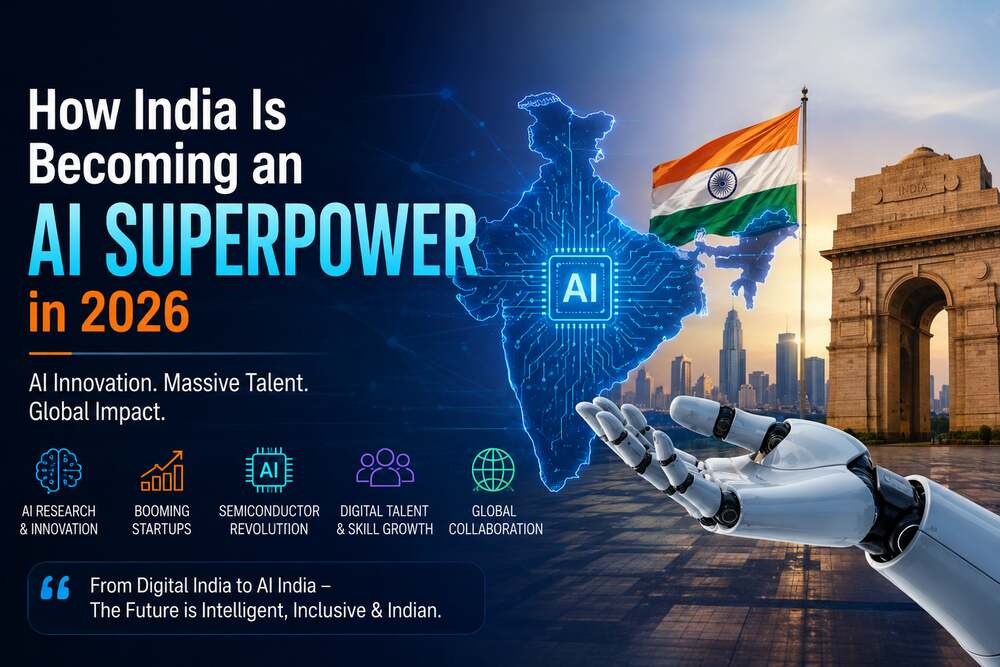
India AI superpower 2026 is no longer a speculative narrative. It is becoming a board-level planning reality shaped by public digital infrastructure, accelerating enterprise adoption, and a rapidly maturing innovation ecosystem. At the same time, global technology leaders cannot separate growth strategy from geopolitical risk. A disruption around the Strait of Hormuz could influence energy prices, logistics timelines, semiconductor availability, and cloud operating economics.
For CIOs, CTOs, and strategy teams, the right question is not whether India matters in AI. The question is how to build a resilient India-focused AI strategy that can scale through volatility.
India’s AI trajectory in 2026 is supported by structural factors rather than a short-term hype cycle. Enterprise leaders are seeing momentum across policy, platforms, infrastructure, and market demand.
This combination gives India a distinct advantage: AI progress is increasingly tied to real economic use cases rather than isolated pilot initiatives.
A key driver of India AI superpower 2026 is convergence across talent supply, startup energy, and enterprise demand. Large technical workforces are being complemented by specialized AI skills, while startups are translating AI capabilities into practical business products.
For global firms, this creates two parallel opportunities: partner with capable local operators and co-build AI products close to high-growth demand centers.
International enterprises should treat India as a strategic AI partner market, not only as a delivery market. The strongest pathways typically include:
Related strategy reads: AI Strategy, Digital Transformation, Cloud Modernization, Supply-Chain Resilience, and Data Governance and Responsible AI.
The Strait of Hormuz is a critical global energy corridor. Any sustained disruption can ripple through technology economics and supply reliability. For AI programs, impacts are usually indirect but material.
Leaders should avoid deterministic assumptions. The prudent approach is scenario planning with explicit triggers and pre-approved mitigation actions.
| Scenario | Likely Tech Effect | Planning Priority |
|---|---|---|
| Short disruption (days to weeks) | Temporary cost spikes and logistics uncertainty | Cost monitoring and procurement pacing |
| Medium disruption (multi-week) | Cloud cost pressure and delayed hardware schedules | Workload reprioritization and vendor coordination |
| Extended disruption (multi-month) | Persistent infrastructure and budget stress | Regional diversification and resilience redesign |
For organizations that want a structured roadmap, start with an AI and resilience consultation to align growth and risk decisions before scaling.
India AI superpower 2026 is emerging through durable structural strengths: policy momentum, digital infrastructure, talent depth, and enterprise demand. The opportunity is significant, but execution discipline will define winners. Organizations that pair India-focused AI expansion with practical geopolitical risk planning will be better positioned to deliver sustainable returns in a volatile global environment.
India combines policy support, digital public infrastructure, expanding compute capacity, strong talent pipelines, and accelerating enterprise adoption, creating a broad AI growth base in 2026.
It improves clarity, encourages adoption pathways, and supports long-term ecosystem capability building, helping enterprises move from pilots to scaled AI implementation.
Financial services, healthcare, retail, manufacturing, and logistics are among the fastest adopters due to clear business use cases and measurable operational gains.
Disruption can raise energy and logistics costs, delay hardware flows, and increase pressure on cloud economics, which can affect AI program timelines and budgets.
Use scenario planning, diversify critical dependencies, tier workloads by business criticality, and set trigger-based operational responses across technology and procurement teams.
It can be highly attractive for many firms, but decisions should be based on sector fit, partner quality, regulatory alignment, and resilience planning rather than broad regional comparisons alone.